


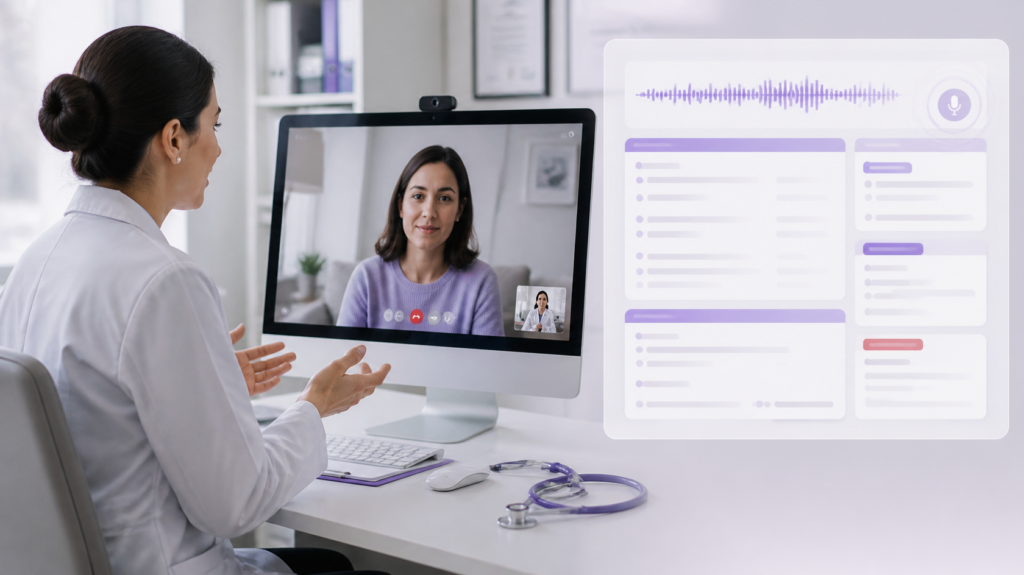
Telehealth appointments allow healthcare providers to evaluate and communicate with patients remotely, but clinical documentation remains an important part of every virtual encounter. An AI medical scribe for telehealth helps transform clinician–patient conversations into structured clinical notes, reducing manual documentation work while keeping physicians responsible for reviewing and approving the medical record.
For U.S. healthcare practices, selecting a telehealth AI scribe involves more than transcription. Providers should assess audio capture, patient consent, HIPAA safeguards, documentation accuracy, EHR compatibility, and clinical review procedures before implementing an AI-supported documentation workflow.
Key Takeaways
- AI medical scribes can convert supported virtual-visit conversations into structured clinical documentation.
- Telehealth workflows require appropriate patient consent, privacy safeguards, and secure technology.
- AI-generated notes should be reviewed and approved by the responsible healthcare professional.
- Compatibility with video conferencing platforms and EHR systems should be verified before implementation.
- Primary care, psychiatry, and virtual clinics can benefit from documentation workflows tailored to their clinical requirements.
What Is an AI Medical Scribe for Telehealth?
An AI medical scribe for telehealth is a clinical documentation tool that uses speech recognition and artificial intelligence to capture supported clinician–patient conversations and generate structured medical notes during or after a virtual consultation.
Unlike traditional manual note-taking, AI-assisted documentation can organize relevant encounter information into formats such as:
- Subjective, Objective, Assessment, and Plan (SOAP) notes.
- History of Present Illness (HPI).
- Review of Systems (ROS).
- Assessment and treatment plans.
- Medication and follow-up documentation.
- Patient instructions and encounter summaries.
The generated documentation is a draft or proposed clinical record, not an independently approved medical decision. The provider must verify that the information accurately reflects the encounter before signing or saving it.
For practices providing remote care, this approach can help reduce repetitive documentation tasks and support a more organized virtual visit workflow.
How Does an AI Scribe Work During Telehealth Video Visits?
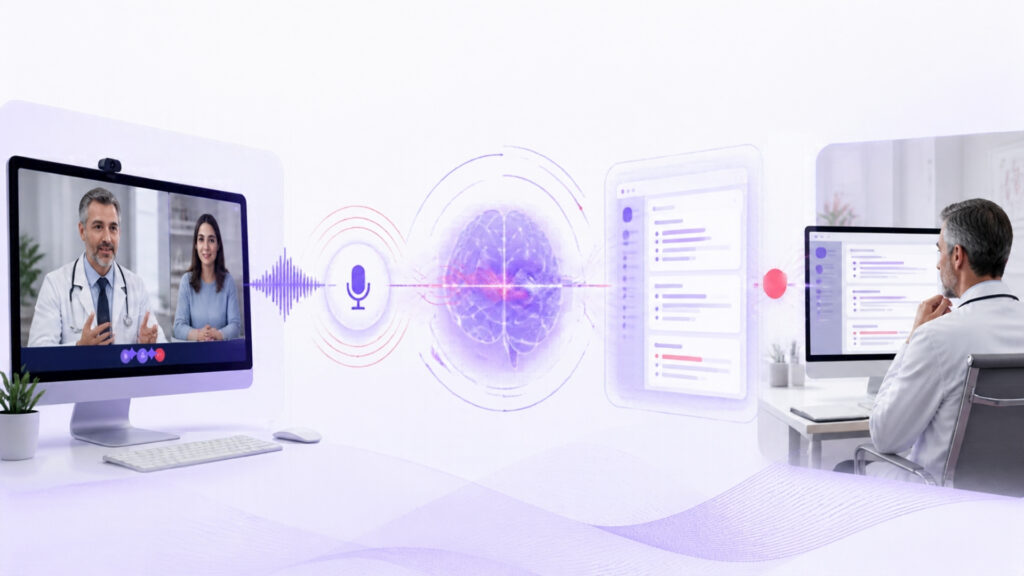
A telehealth AI scribe generally works through a sequence of audio capture, transcription, clinical language processing, note generation, and provider review.
However, the actual process depends on the scribe software and its compatibility with the telehealth platform.
Step 1: Prepare the Virtual Appointment
Before the consultation, staff or providers prepare the patient chart and confirm that the telehealth platform and documentation tools are ready.
Preparation may include:
- Confirming patient identity.
- Reviewing relevant medical history.
- Checking medications and allergies.
- Confirming the appointment type.
- Completing applicable telehealth consent procedures.
- Explaining the use of AI-assisted documentation when appropriate.
Step 2: Capture the Clinical Conversation
During the video appointment, the AI scribe receives supported audio from the clinician–patient conversation.
Depending on the software, audio may be captured through an integrated telehealth application, a supported desktop audio source, or another authorized recording workflow.
The practice should verify whether the solution supports its existing video conferencing platform. Compatibility with Zoom, Microsoft Teams, or other meeting applications should never be assumed.
Step 3: Convert Speech Into Clinical Information
Speech recognition converts spoken conversations into text. Natural language processing and other AI technologies can then identify relevant clinical information.
For example, the system may organize information into:
- Patient-reported symptoms.
- Relevant medical history.
- Medication information.
- Clinical observations.
- Assessment and treatment plans.
- Follow-up instructions.
The quality of the output depends on audio clarity, speaker identification, medical terminology, accents, overlapping speech, and the completeness of the encounter.
Step 4: Generate Structured Clinical Notes
The AI medical scribe organizes the extracted information into the selected documentation format.
A primary care provider may prefer SOAP notes, while a behavioral health professional may require DAP or other specialty-specific formats.
The documentation template should reflect the practice’s requirements rather than forcing every consultation into the same structure.
Step 5: Physician Review and EHR Documentation
The provider reviews the generated note, corrects missing or inaccurate information, and confirms that the assessment and plan accurately represent the consultation.
Once approved, the note can be transferred or saved into the EHR through the supported integration or documentation workflow.
The physician remains responsible for the final clinical record. AI-generated documentation should not be treated as a substitute for professional judgment or verification.

AI Medical Scribe vs. Virtual Medical Scribe for Telehealth
Healthcare practices generally consider two approaches when improving remote clinical documentation: AI-only documentation software and human-supported virtual medical scribing.
| Feature | AI Medical Scribe | Human Virtual Medical Scribe |
|---|---|---|
| Documentation | AI-generated notes | Human-prepared notes |
| Conversation processing | Automated speech recognition and AI | Human listening and documentation |
| Note review | Provider review, with optional additional quality checks | Scribe review and provider verification |
| Customization | Software-supported templates | Practice-specific instructions and workflows |
| Availability | Depends on platform and subscription | Depends on staffing and service coverage |
| Best suited for | Automated documentation workflows | Practices requiring direct human documentation assistance |
A third option combines AI-generated notes with human review. This hybrid approach can provide an additional quality-control step before documentation reaches the provider for final approval.
PennHealth Informatics offers virtual medical scribing and real-time charting services that combine remote documentation support with ambient AI-assisted workflows. Practices can explore PennHealth’s medical scribing services to understand its human-supported documentation approach.

How AI Medical Scribing Supports Different Telehealth Specialties
The documentation requirements of a virtual consultation vary according to the specialty, patient population, and type of clinical service.
1. Primary Care Telehealth
Primary care physicians frequently manage follow-up appointments, chronic conditions, medication reviews, and routine consultations.
An AI scribe can help organize:
- Patient-reported symptoms.
- Medical and medication history.
- Blood pressure and other patient-reported home measurements.
- Assessment and treatment plans.
- Follow-up recommendations.
Providers should verify that patient-reported measurements are clearly distinguished from measurements obtained directly during an examination.
2. Psychiatry and Behavioral Health
Psychiatry and behavioral health consultations often involve detailed conversations about symptoms, emotional well-being, treatment progress, and medication response.
AI-assisted documentation may help structure relevant information into progress notes and follow-up records.
However, clinicians should carefully review contextual details, sensitive disclosures, patient statements, and risk-related documentation. Automated summaries must not replace clinical assessment.
3. Multilingual Telehealth Consultations
U.S. healthcare practices may serve patients who prefer communicating in languages other than English.
Documentation workflows should preserve the meaning of patient-reported symptoms and distinguish translated information from independently verified clinical findings.
For practices supporting Spanish-speaking patients, Chase Clinical Documentation’s Spanish AI Medical Assistant describes AI-assisted Spanish-English communication, patient intake, and human-controlled documentation support.
AI translation should not be treated as a replacement for qualified language assistance when that is required by law, regulation, or clinical circumstances.

Patient Consent and HIPAA Considerations for Telehealth AI Scribes
Patient privacy is one of the most important considerations when implementing AI medical scribing in virtual healthcare.
A telehealth consultation may contain protected health information (PHI), including medical history, diagnoses, medication details, and personal disclosures.
Practices should distinguish between consent for telehealth itself and the disclosures or permissions relevant to recording, transcription, and AI-assisted processing.
What Should Providers Consider Before Capturing a Virtual Visit?
- Explain when AI-assisted documentation is being used.
- Establish a clear patient notification and consent process.
- Identify whether audio is recorded, streamed, transcribed, or retained.
- Explain applicable privacy practices.
- Confirm how patient information is transmitted and stored.
- Review the vendor’s Business Associate Agreement (BAA), where applicable.
- Restrict access to authorized personnel.
- Establish appropriate retention and deletion procedures.
The HIPAA Rules require covered healthcare providers and health plans to protect PHI when providing telehealth services. HHS guidance also addresses technology vendors and Business Associate Agreements.
Importantly, HIPAA compliance is not established simply because a software provider advertises its product as HIPAA compliant. Practices must assess the actual technology, contractual arrangements, safeguards, and organizational policies.
Consent requirements can vary by state and circumstance. Practices should review applicable state laws and organizational policies with qualified legal or compliance professionals.
Useful guidance:
For a more focused discussion of AI scribe consent, see EzyScribe’s guide to AI medical scribe patient consent .
EHR Integration: Connecting Telehealth Documentation With Patient Records
An AI medical scribe should fit into the practice’s existing clinical documentation workflow.
Without an appropriate EHR handoff, providers may still need to transfer information manually, creating additional administrative work and opportunities for documentation errors.
Before selecting telemedicine documentation software, practices should assess:
- Compatibility with their existing EHR.
- Available direct integrations and APIs.
- Support for relevant interoperability standards, including HL7 FHIR where applicable.
- SOAP and specialty-specific templates.
- Provider editing and sign-off capabilities.
- Secure transfer of clinical information.
- Audit trails and access permissions.
- Downtime and error-handling procedures.
For example, a virtual primary care consultation may generate a SOAP note that needs to be reviewed and entered into the patient’s electronic chart. The practice should verify whether this process is automated, requires manual transfer, or involves an additional documentation team.
For more information about implementation and interoperability, read EzyScribe’s AI Medical Scribe EHR Integration guide .
Practices interested in AI-supported clinical documentation can also review PennHealth’s EzyScribe software information .
What Should U.S. Practices Evaluate Before Choosing a Telehealth AI Scribe?
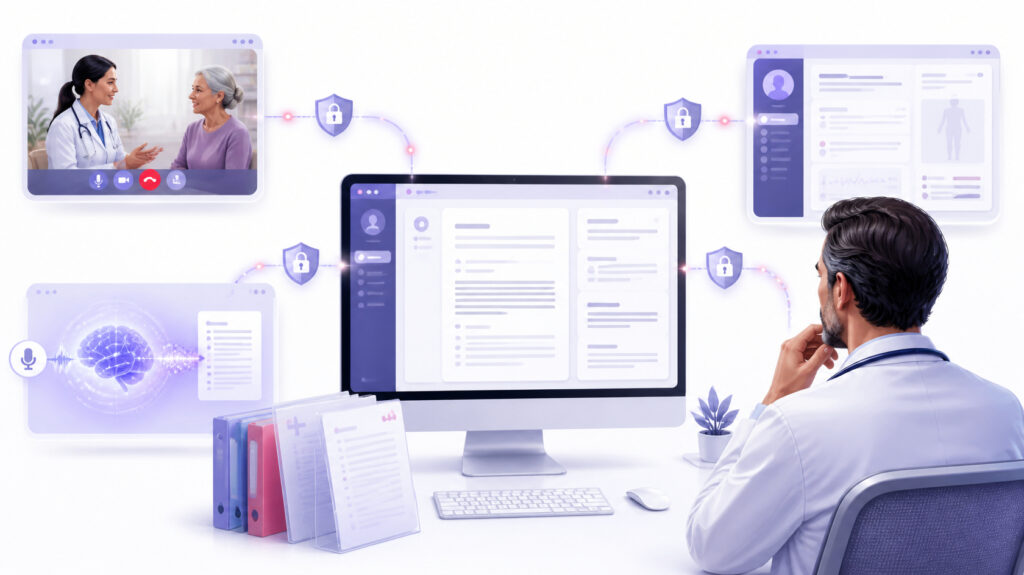
Choosing an AI scribe requires evaluating both clinical documentation requirements and technical compatibility.
Use this checklist when comparing solutions:
| Evaluation area | Questions to ask |
|---|---|
| Telehealth compatibility | Does it support your existing video and audio workflow? |
| Audio capture | Can it capture the required audio reliably? |
| Patient consent | Does the workflow support appropriate notification and consent? |
| HIPAA safeguards | Are appropriate security controls and BAAs available? |
| Documentation quality | Can it generate accurate, clinically relevant notes? |
| EHR integration | Does it connect with your existing EHR? |
| Human review | Can providers or authorized documentation staff review notes? |
| Specialty support | Are templates suitable for your clinical specialty? |
| Language support | Does it support the languages required by your patient population? |
| Data management | Are retention, deletion, and access policies clearly documented? |
A small pilot involving representative appointment types can help practices assess usability, note quality, workflow compatibility, and staff acceptance before wider implementation.

How PennHealth and EzyScribe Fit Into AI-Assisted Documentation
Healthcare organizations evaluating AI medical scribing should consider both software functionality and the documentation support model.
PennHealth Informatics provides medical scribing services, including real-time charting and AI-supported virtual documentation. Its service model includes remote human scribing support and documentation workflows.
EzyScribe provides AI medical scribe software designed to convert supported patient-provider conversations into structured clinical documentation. Its published capabilities include SOAP documentation, customizable formats, and EHR-oriented workflows.
These approaches address related but distinct requirements: software-assisted note generation and human-supported clinical documentation.
Practices can also explore PennHealth’s AI solutions for healthcare providers to understand its wider healthcare automation offerings.
For additional information about AI medical scribe implementation and documentation workflows, visit the EzyScribe AI Medical Scribe platform and Chase Clinical Documentation’s AI Medical Scribe service.
Conclusion: Building Better Telehealth Documentation Workflows
AI medical scribing can help U.S. healthcare practices organize virtual patient conversations into structured clinical documentation while reducing repetitive note-taking tasks.
However, successful implementation requires more than selecting an AI transcription tool. Providers must consider telehealth platform compatibility, patient consent, HIPAA safeguards, clinical accuracy, EHR integration, and physician review.
Whether a practice chooses an AI-only solution, a human virtual medical scribe, or a hybrid documentation model, the priority should remain accurate clinical records and responsible patient care.
Looking to improve your telehealth documentation workflow?
PennHealth Informatics supports healthcare organizations with medical scribing and AI-assisted documentation solutions. Explore the available services or request a consultation with PennHealth Informatics to discuss your practice’s documentation requirements.

Frequently Asked Questions
1. What is an AI medical scribe for telehealth?
An AI medical scribe for telehealth uses speech recognition and artificial intelligence to convert supported virtual patient-provider conversations into structured clinical notes. Providers review and approve the documentation before it becomes part of the medical record.
2. Can an AI medical scribe work during Zoom or Microsoft Teams appointments?
Some AI scribe solutions support telehealth audio capture through integrated platforms or compatible desktop audio sources. Compatibility varies by product, so clinics should verify support for their specific video conferencing software before implementation.
3. Does an AI scribe record the entire telehealth consultation?
Not necessarily. Depending on the software, it may capture live audio, process an authorized audio stream, or transcribe a consultation through another supported method. Practices should verify what information is captured, whether recordings are retained, and how the data is processed.
4. Do patients need to consent to AI medical scribing?
Practices should clearly inform patients about AI-assisted documentation and follow applicable consent, recording, privacy, and organizational requirements. Telehealth consent and consent or disclosure requirements relating to audio recording and AI processing should be considered separately.
5. Can AI scribes automatically upload notes into an EHR?
Some solutions provide direct EHR integration, while others require manual review, copying, exporting, or another approved transfer method. Clinics should verify integration capabilities with their specific EHR before choosing a solution.
6. Is an AI medical scribe HIPAA compliant?
HIPAA compliance depends on the complete workflow, including the technology vendor, safeguards, contracts, access controls, and the healthcare organization’s responsibilities. A product’s marketing claim alone does not establish compliance.
Contact Us
Recent Posts


How AI Medical Scribing Improves Revenue Cycle Management
January 23, 2026

Choosing the Best AI Scribing Software for Your Healthcare Practice
December 19, 2025