


Multilingual AI Medical Scribing for U.S. Clinics: What Providers Should Know
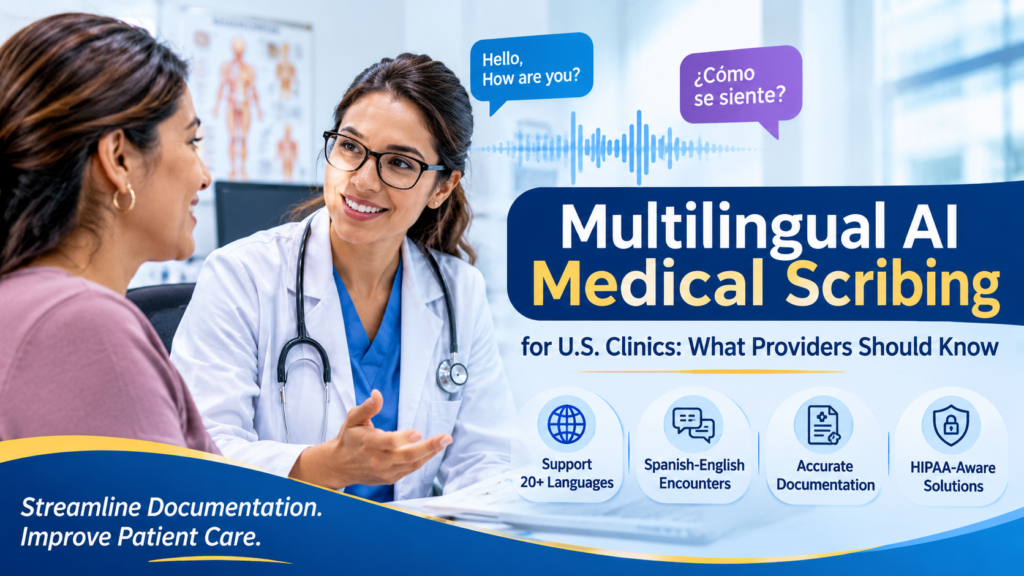
Healthcare providers across the United States serve patients who speak different languages. For clinics treating Spanish-speaking and multilingual populations, documenting conversations accurately can create additional administrative challenges. A multilingual AI medical scribe helps address these challenges by converting spoken clinical conversations into structured medical documentation.
Multilingual AI medical scribe software uses speech recognition and natural language processing to support clinical documentation in multiple languages. Solutions such as EzyScribe, developed by PennHealth Informatics, advertise support for more than 20 languages. However, healthcare practices should evaluate language recognition, medical terminology, mixed-language conversations, privacy, and clinician verification before selecting a solution
Key Benefits of Multilingual AI Medical Scribing
Supports documentation workflows involving multiple languages.
Helps reduce manual clinical documentation tasks.
Supports Spanish-speaking patient encounters.
Organizes clinical conversations into structured notes.
Provides an opportunity to improve documentation workflows across multilingual practices.
Allows clinicians to review and edit AI-generated notes before finalization.
Why Do U.S. Clinics Need Multilingual AI Medical Scribes?
Language diversity is an important consideration for American healthcare practices. Primary care clinics, community health centers, and bilingual medical facilities regularly encounter patients who prefer communicating in Spanish or other languages.
When physicians document these consultations, important information must be accurately captured, including symptoms, medical history, medications, allergies, and treatment plans.
Traditional documentation workflows may require additional time when conversations involve language differences or interpreter assistance.
A multilingual AI medical scribe can support these workflows by processing spoken conversations and preparing clinical notes for physician review.
1. Supporting Spanish-Speaking Patients
Spanish is particularly relevant for healthcare providers serving diverse U.S. communities. A Spanish AI medical scribe can support documentation involving Spanish-language conversations, provided the platform has the appropriate language-recognition capabilities.
Clinics should verify whether the software can recognize regional accents, medical terminology, and patient-specific expressions.
2. Managing Spanish-English Clinical Encounters
Some consultations involve patients and physicians switching between Spanish and English. This is known as code-switching.
For example, a physician might ask questions in English while a patient explains symptoms in Spanish. The conversation may also include English medical terminology, Spanish descriptions, and medication names.
Multilingual AI scribe software should be evaluated for its ability to recognize these language changes without losing important clinical information.
3. Supporting Consistent Documentation
Clinical documentation must preserve the meaning of patient conversations.Inaccuracies in clinical documentation can affect downstream billing, coding, and continuity of care.
Important information includes:
Chief complaints and symptom history.
Current medications and allergies.
Medical and surgical history.
Review of systems.
Examination findings.
Assessment and treatment plans.
AI-generated documentation should accurately reflect the encounter rather than introduce assumptions or information that was never discussed.
How Does Multilingual AI Medical Scribe Software Work?
Multilingual AI scribe software generally combines speech recognition, language processing, and clinical note generation.
1. Automatic Speech Recognition
Automatic Speech Recognition (ASR) converts spoken conversations into written text. Ambient AI medical scribe systems are designed to process speech in supported languages.
Their performance should be evaluated using different accents, speaking speeds, and medical vocabulary.
2. Language Identification
Language identification helps recognize the language being spoken. This is especially important when conversations switch between Spanish and English.
Clinics should confirm whether language selection is automatic or requires users to select a preferred language before an encounter.
3. Natural Language Processing
Natural Language Processing (NLP) helps identify relevant information within a conversation, including symptoms, medications, clinical findings, and treatment plans.
The technology helps organize information into a format suitable for clinical documentation.
4. Clinical Note Generation
After processing the conversation, the software may prepare structured notes using real-time charting workflows such as:
| Section | Documentation |
|---|---|
| HPI | History of present illness |
| ROS | Review of systems |
| Examination | Clinical examination findings |
| Assessment | Provider’s assessment |
| Plan | Treatment and follow-up |
The physician should review and approve the final documentation.
What Happens During a Spanish-English Clinical Encounter?
Consider a primary care consultation involving a Spanish-speaking patient.
Patient: “Me duele la cabeza desde hace tres días.”
Translation: I have had a headache for three days.
Physician: “Have you experienced nausea or blurred vision?”
Patient: “No tengo náuseas, pero siento un poco de mareo.”
Translation: I do not have nausea, but I feel slightly dizzy.
A multilingual AI medical scribe may help organize the relevant information into a clinical note:
HPI: Headache for three days.
Associated symptoms: Dizziness reported.
Nausea: Denied.
Further assessment: To be completed by the physician.
This example illustrates the importance of preserving the patient’s original meaning. The software should not independently diagnose conditions or add clinical findings that were not established during the consultation.
When a qualified interpreter participates, the practice should also evaluate how the documentation system captures the interpreter-mediated conversation.
Challenges to Consider When Choosing Multilingual AI Scribe Software
Supporting multiple languages does not automatically guarantee accurate clinical documentation. Healthcare organizations should evaluate several factors before implementation.
Language Recognition and Medical Terminology
Medical conversations contain specialized vocabulary, abbreviations, medication names, and clinical expressions. Recognition errors can affect the accuracy of patient records.
Practices should request demonstrations using representative clinical conversations.
Regional Accents and Language Variations
Spanish pronunciation and vocabulary vary across regions. Software should be tested with speech patterns representative of the clinic’s patient population.
Translation Versus Transcription
These are different capabilities:
Transcription: Converts spoken words into written text.
Translation: Converts information from one language into another.
Clinical summarization: Organizes relevant information into structured notes.
A multilingual AI medical scribe may support some or all these functions. Clinics should confirm which capabilities are actually available.
Clinician Review
AI-generated notes should remain subject to human verification. Understanding how AI medical scribes affect physician clinical reasoning can help providers adopt appropriate oversight habits. Providers must check medication names, dosages, symptoms, allergies, examination findings, and treatment plans before approving and signing documentation.
How Should Clinics Evaluate a Multilingual AI Medical Scribe?
Before implementing multilingual AI scribe software, healthcare practices should consider the following checklist. For a broader selection guide, see our post on choosing the best AI scribing software for your healthcare practice.
| Evaluation area | What to verify |
|---|---|
| Language support | Which languages are officially supported? |
| Spanish transcription | Can the system process Spanish conversations? |
| Mixed-language encounters | Can it handle Spanish-English switching? |
| Medical terminology | How accurately does it recognize clinical terms? |
| Documentation | Can it generate structured medical notes? |
| Translation | Does it translate or preserve the original language? |
| EHR compatibility | Does it fit the existing documentation workflow? See our AI medical scribe EHR integration guide |
| Security | What safeguards protect patient information? |
| Clinician review | Can providers edit and approve generated notes? |
A practical evaluation should include different accents, specialties, conversation styles, and language combinations.
How EzyScribe Supports Multilingual AI Medical Scribing
PennHealth Informatics offers EzyScribe, an AI-powered medical documentation solution designed to support healthcare documentation workflows.
According to PennHealth’s published AI Solutions information, EzyScribe supports more than 20 languages through its AI Scribe solution.
Its published technology capabilities include:
Multilingual AI medical scribing.
Ambient AI-based documentation.
Automatic Speech Recognition.
Natural Language Processing.
Clinical documentation workflows.
EHR interoperability capabilities using HL7 FHIR standards.
These capabilities make EzyScribe relevant to healthcare practices exploring multilingual AI documentation.
However, supporting more than 20 languages does not automatically establish that every mixed-language conversation, translation direction, or regional accent has been validated. Clinics should confirm their specific requirements with PennHealth before implementation.
Accurate documentation also has a direct impact on revenue. Learn how AI medical scribing improves revenue cycle management when documentation is complete and timely.
Explore PennHealth AI Solutions and EzyScribe Software for additional product information.
How Does Chase Clinical Documentation Support Multilingual Documentation Workflows?
AI technology is one approach to improving clinical documentation. Some healthcare practices may also require human-assisted documentation, particularly when encounters involve complex terminology or additional review requirements.
Chase Clinical Documentation provides healthcare documentation services, including virtual medical scribing, AI-assisted documentation, medical transcription, and bilingual English and Spanish documentation support through its dedicated Spanish AI medical assistant platform.
These services are relevant to practices evaluating how human documentation professionals and AI-assisted workflows can complement their clinical operations.
While AI medical scribes can support initial note preparation, human-assisted documentation offers another approach for managing documentation requirements.
Explore Chase Clinical Documentation and its Virtual Medical Scribe Services to learn more.
HIPAA and Patient Privacy Considerations
Healthcare organizations must evaluate privacy and security before introducing AI medical scribing.
Under HIPAA, covered entities and business associates have responsibilities for protecting electronic protected health information (ePHI). Clinics should assess vendor security safeguards, access controls, data retention policies, recording practices, and Business Associate Agreement (BAA) requirements where applicable.
Practices should also determine whether patient notification or consent is required under applicable federal and state laws and organizational policies.
AI documentation software does not automatically make a healthcare organization HIPAA compliant. Compliance depends on the complete technology and operational environment.
Conclusion
Multilingual AI medical scribing can support U.S. healthcare practices managing documentation across different spoken languages. However, selecting the right solution requires evaluating language recognition, Spanish-English conversations, medical terminology, EHR compatibility, patient privacy, and clinician verification.
PennHealth Informatics offers EzyScribe with advertised support for more than 20 languages, making it a relevant option for practices exploring multilingual clinical documentation.
For organizations requiring additional documentation support, Chase Clinical Documentation’s Spanish AI medical assistant and virtual medical scribing services offer an effective complement to AI-first workflows.
Looking to improve your clinical documentation workflow? Contact PennHealth Informatics to discuss EzyScribe, supported languages, and your practice’s requirements.
Frequently Asked Questions
Common questions about multilingual AI medical scribing and clinical documentation.
01. What is a multilingual AI medical scribe? +
It is software that processes spoken clinical conversations in multiple languages and prepares structured medical documentation using speech recognition and language-processing technology.
02. Can an AI medical scribe support Spanish-speaking patients? +
Yes. Some platforms support Spanish-language speech recognition and documentation. Clinics should verify language-specific performance and medical terminology recognition.
03. Can AI medical scribes handle Spanish-English conversations? +
Some systems support multiple languages, but mixed-language encounters require specific testing. Practices should confirm whether the software can recognize language switching accurately.
04. Does multilingual AI scribe software automatically translate medical notes? +
Not necessarily. Transcription, translation, and clinical summarization are different functions. Confirm the available features with the vendor.
05. Is multilingual AI medical scribing HIPAA compliant? +
Language support does not establish HIPAA compliance. Healthcare organizations must evaluate security safeguards, vendor agreements, data handling, and applicable privacy requirements.
06. Does EzyScribe support multiple languages? +
PennHealth Informatics advertises support for more than 20 languages through its AI Scribe solution. Contact PennHealth to confirm the languages and specific multilingual workflows available.
Contact Us
Recent Posts


How AI Medical Scribing Improves Revenue Cycle Management
January 23, 2026

Choosing the Best AI Scribing Software for Your Healthcare Practice
December 19, 2025